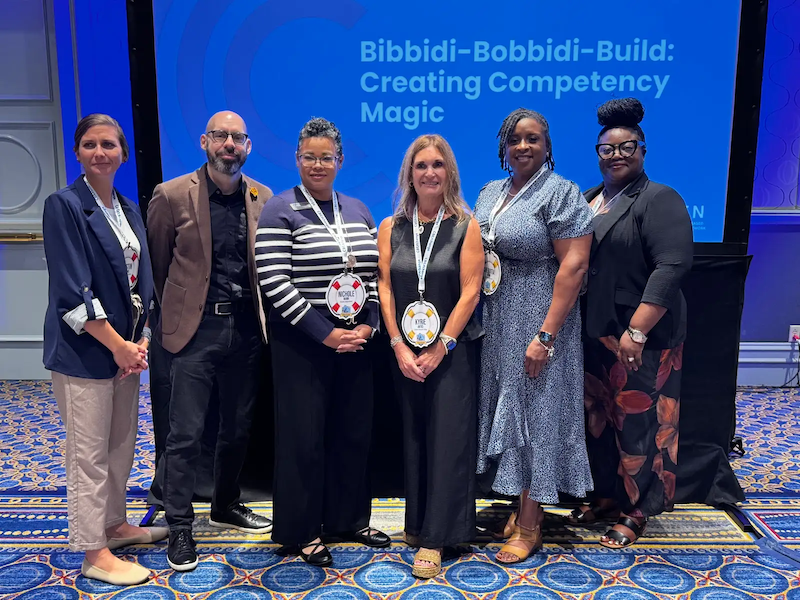
Three Coahoma Community College leaders attended the CBExchange 2026 in Orlando, Florida, to explore competency-based education strategies aimed at strengthening workforce preparation and student success.
Hosted by the Competency-Based Education Network (C-BEN), the national conference brought together educators, employers, policymakers and workforce leaders to examine how colleges can better connect academic instruction with the skills required in today's workforce. Representing Coahoma Community College were Kyrie Nilson Antici, executive director; Tamara Washington-Travis, director of Adult Education; and Dr. Chequitia Dixon, dean of Health Sciences.
The conference focused on advancing competency-based education (CBE), an instructional approach that emphasizes students' demonstrated knowledge and skills rather than time spent in a classroom. Discussions addressed curriculum development, meaningful assessments, employer partnerships and strategies for improving educational outcomes.
For Coahoma's representatives, the conference offered practical insights into strengthening academic programs and preparing students for employment opportunities across the Mississippi Delta and beyond.
Antici emphasized the importance of ensuring educational programs reflect the expectations of employers and evolving industry demands.
"My key takeaway from C-BEN was the importance of engaging employers directly to understand the competencies and skills they need from our students upon program completion," Antici said. "When we listen to industry, we can better align our programs with the workforce needs of today and tomorrow."
The emphasis on employer engagement reflects the college's continued efforts to connect classroom instruction with workforce expectations, ensuring students develop skills that translate into meaningful career opportunities.
For Washington-Travis, the conference reinforced the value of creating flexible educational pathways that recognize the experiences and abilities of adult learners.
"CBExchange reinforced for me that the future of education is about meeting learners where they are and recognizing what they can do, not just how long they have spent in a classroom," Washington-Travis said. "I see this every day in Adult Education. We have an opportunity to strengthen the connection between education and workforce by creating competency-based, skills-focused pathways that help our students gain meaningful credentials, build confidence, and move into careers with family-sustaining wages."
Washington-Travis also emphasized the importance of collaboration among educational institutions, workforce organizations and employers in expanding opportunities for students.
"I left the conference reminded that real change happens when education, workforce, and employers work together with a shared purpose—creating career pathways that provide more opportunities for every learner to succeed," she said.
The conference's focus on competency-based instruction also held particular significance for Coahoma's Division of Health Sciences as the college prepares to transition its Associate Degree Nursing Program to a competency-based curriculum in fall 2027.
Dixon highlighted a collaboration between C-BEN and the American Association of Colleges of Nursing (AACN) to support competency-based nursing education through faculty development, curriculum design and assessment resources. She identified the initiative as a valuable resource for Coahoma's upcoming curricular transition.
"Through our partnership with C-BEN via Complete College America, I look forward to accessing valuable resources and building connections to support Coahoma Community College's implementation of a competency-based curriculum in Fall 2027," Dixon said. "Our goal is to prepare nursing graduates with the knowledge, clinical skills, and judgment needed to provide safe, effective patient care."
The planned transition represents an important step in aligning nursing instruction with measurable competencies that support clinical readiness and effective patient care.
Across the three areas of institutional leadership, the conference underscored a shared priority: ensuring students gain the knowledge, practical skills and credentials necessary to succeed in an evolving workforce.
By engaging with national education and industry leaders, Coahoma Community College continues to explore strategies that connect academic achievement with career preparation, expand opportunities for adult learners and support high-quality health sciences education.
The insights gained at CBExchange 2026 will help inform ongoing discussions about curriculum development, employer engagement and student success as the college works to meet the educational and economic needs of the communities it serves.